Showing posts with label capileira. Show all posts

Wednesday

Visit of the Acequia Baja

This sunday we set off to check the Acequia Baja.

Acequia baja Capileira

In order to get there we took our car and passed Capileira until the end of the asphalt and continued up and up and up until we got to Cortijo Simon in El Prado Grande.
Cortijo Simon is easy to find, it is the only Cortijo you find on your way up to the barrier. There are lovely cherry trees and the cortijo is on the left hand side just before a bend in the road.

Cortijo Simon o Cortijo del Noruego


We left our car there and got up to the acequia, which was filled with nice cold fresh spring water, making a beautiful noise on her way down to Pitres.

We followed the acequia and enjoyed the vast views over Tablones, the Presa de Rules and the Sierra de Tejeda and Almijara. We discovered some butterflies and small flowers.

Florecillas

We continued our walk to Cortijo Piedras Blancas. There we found this old chimney still standing strong.

Old chimney near Cortijo Piedras Blancas


We crossed the dirt track to the Cortijo Piedras Blancas and continued for a while spotting the Loma Pua pipelines and a little later the Mulhacen discovered herself to us, in the midst of a small pineforest.

Mulhacen


We then had to return and got onto the dirt track. There we discovered some lazy lizzards who were obviously taking advantage of the first sunshine of the year and some small birds.

Lazy lizards

We really enjoyed our stroll in the countryside and hope to do some more excursions this year.
On our way down we saw a huge lizard, some 75cm on the track going down to Capileira. Really a very interesting excursion this was.


Thursday

Spring in the Alpujarras

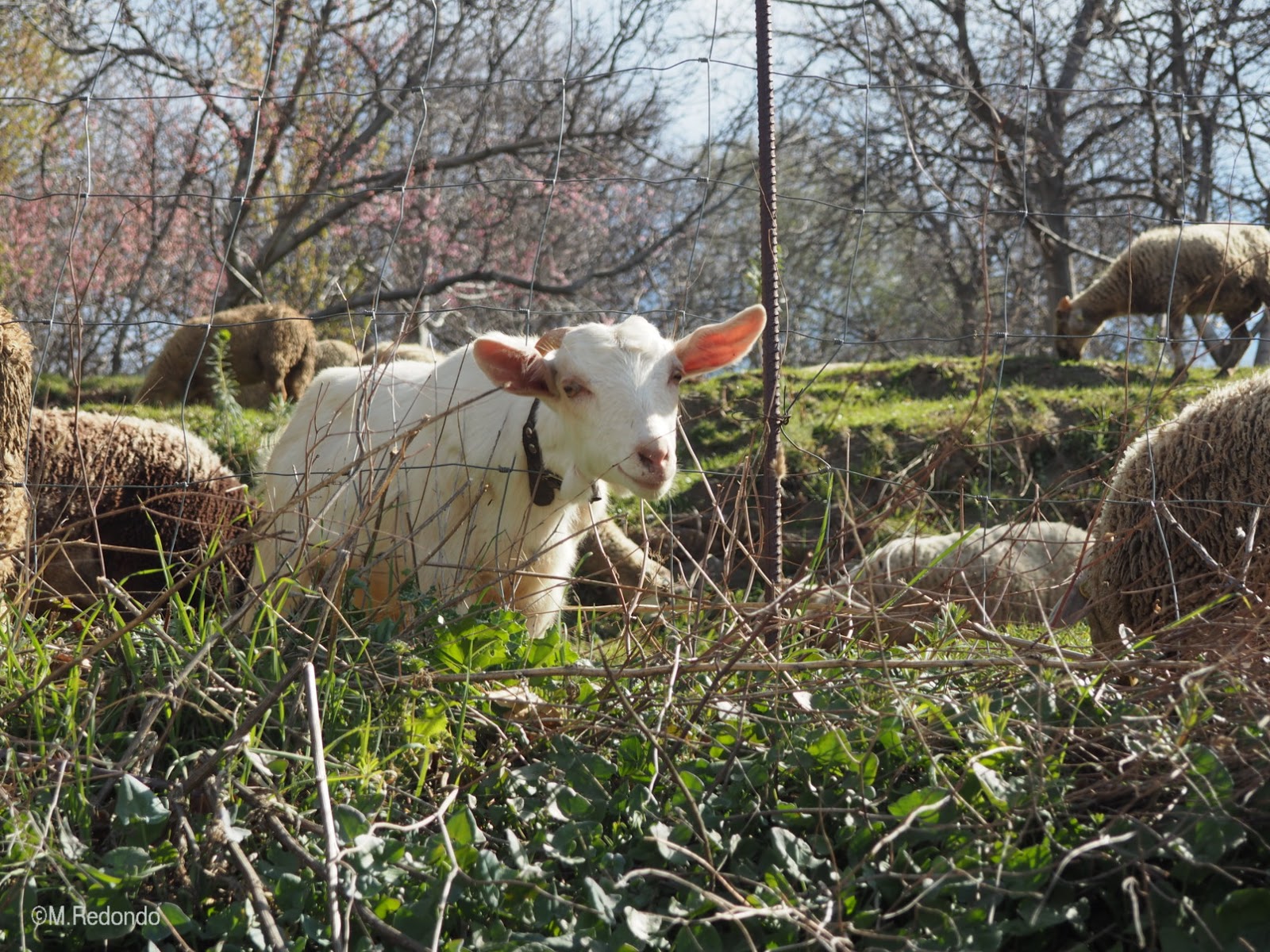
We just want to share with you all these pictures of these hungry sheep and one goat we met this week walking from Bubion to Capileira. They really are enjoying the fresh grass after the rains and the snow and they even don't bother to lift their heads as the notice somebody very nearby: eat, eat and eat! This year you will be received by an extremely green Alpujarra if you have the chance to come over and visit us.

Sheep Alpujarra 2017 near Capileira 1

Sheep Alpujarra 2017 near Capileira 2

Sheep Alpujarra 2017 near Capileira 3

Sheep Alpujarra 2017 near Capileira 4

Sheep Alpujarra near Capileira 5 2017

Goat Alpujarra near Capileira 2017


Wednesday

Visit Sierra Nevada National Park

Summer is coming up again and this is the ideal time to go and see the spring in the Sierra Nevada, the biggest national park of Spain. The Sierra Nevada mountainrange is some 80 km long and 15 till 30 km wide.
From Capileira (75 km distance from Granada-city) there are buses going up to 2700 m to the Mirador the Trevelez or Alto del Chorillo area. From here the climb to the Mulhacen takes you (depending on experience and condition) some 2,5 till 3 hours.
Be prepared though for any type of weather, so always take good walking boots for the rugged terrain, a windjack, loads of suncream, because the AV-radiation on many days is nearly 10 and of course water and food.
Sierra Nevada mountains and Veleta 3392m

More information 

The Sierra Nevada Nature Area, comprising its National Park and Nature Park, is an impressive, compact mountain range which boasts the highest peak on the Iberian Peninsula: Mulhacén (3,482 metres). It forms part of the Penibetic range, which stretches from the south-eastern part of Granada province to the western borders of Almería. Due to the great variety of its landscapes and the uniqueness of its natural features, Sierra Nevada is included in several different categories of protection. Apart from being a Nature Park and National Park, it is also an internationally recognised Biosphere Reserve.

Thanks to its altitude range and climate, it is home to a large number of plants which have adapted very specifically to the harsh conditions found there. On the higher peaks, like Veleta (3392m) and Tajo de los Machos, unique species such as the Sierra Nevada violet and plantago nivalis (known locally as "estrella de las nieves" - snowstar) can be found growing beneath overhanging rocks and in cracks in the rock faces.

Estrella de las Nieves or "Star of the Snows", Lat:Plantago Nivalis
At this altitude there are also beautiful glacial valleys such as Siete Lagunas. In the mid-mountain area, the landscape is dominated by deciduous woodland with Pyrenean oaks, maples, wild cherry and chestnut trees. This woodland alters the appearance of the landscape from one season to another: in autumn the trees begin to shed their leaves, producing an overall golden brown colour; but when the new shoots bud in spring the mountainside is flooded by deep tones of green. At lower altitudes there are holm oak groves like those at Montenegro and the watercourses are flanked by riverine forests.

Mulhacen, april 2012
This great variety in plant life and climate has contributed to the area's wealth of animal species. In the higher regions, alpine accentors, blue rock thrushes and red-billed choughs can be seen in flight. If you wait quietly, a dipper, an oropendola or a brightly coloured kingfisher may just appear among the shadows of the riverine woodland. A golden eagle could also make an appearance at any time.


The woodland and thick scrubland supports a large community of mammals, including wild boar, foxes, badgers and genet cats. From the Dílar River Valley and Poqueira Gorge you can see mountain goats, a species very common in these mountains, climbing up the slopes and walking along the rocky peaks. The invertebrate population is also very representative, many species being unique to this environment. There are over twenty species of butterfly and more than thirty types of beetle.

endemic beetle of Sierra Nevada: baetica ustulata

This area was occupied by Tartessians, Phoenicians, Greeks and Romans, but it was unquestionably the Moors who left the greatest legacy. Their influence can still be seen today in local architecture and in irrigation systems known as "acequias". The villages of the Alpujarras are of great architectural interest, with their white houses clinging to the mountainside, their small windows, flat roofs and narrow chimneys, not to mention the characteristic porches, "tinaos", which span the streets from one side to another.

Those interested in skiing, mountaineering, fishing or walking will find this the perfect place to spend their holidays.
Information from the Junta de Andalucia website

Reservation of a seat in the buses leaving from Capileira: 958-763090 or mobile phone: 671564406
More information about Sierra Nevada National Park:
Ministry of Environment
Junta de Andalucia

Accomodation in the Alpujarras, Sierra Nevada Natural Park
Casa de la Luz Bubión, capacity up to 4 people
Casa Launa, Pitres, capacity up to 6 people
Livingroom Casa Launa, Pitres
Casa Milagro Bubión, capacity up to 6 people
Casa Capilerilla Pitres, capacity up to 6 people with private pool
Casa el Niño Bubión, capacity up to 9 people

Thursday

Meeting of acuarel painters in Capileira

Last weekend, the Andalusian Acuarellist Asociation organised a meeting in Capileira.
All the corners were full of more or less professional painters. They organised an exhibition in Hotel Finca los Llanos and they really enjoyed the fine spring weather these days.


More information about the Association you can find on: www.acuarelistasdeandalucia.es


Monday

More about the Alpujarras


The region of mountain villages known as Las Alpujarras clings to the southern flanks of the Sierra Nevada, cloven by deep, sheltered valleys and gorges which run down towards the Mediterranean. The Alpujarra, as it is popularly known, in the singular, is famous throughout Spain because of its unique mini-ecology. Its terraced farmlands are constantly watered by the melting snow from above, constituting a high-altitude oasis of greenery which stands in dramatic contrast to the arid foothills below. This is ideal hiking terrain for adventurous travellers - the average altitude is 4,000 feet above sea level.

The cultural interest of the region lies in its, which were the last stronghold of the Spanish Muslims, or Moors. Soon after the Castillians took Granada in 1492, all the city´s Moors were forced to convert to Christianity allthough they were allowed to live in the Alpujarras.. Constant pressure from the Christians led to a bloody uprising, the Morisco Rebellion of 1568, which was ruthlessly crushed out, with the public execution of the leader, Ben Humeya. Soon followed a royal decree expelling from the Kingdom of Granada all people of Arab descent.

The villages of the Alpujarra were resettled with some 12,000 Christian families brought by King Philip II from all parts of Spain. However, these unique hamlets have retained their traditional Berber architecture - terraced clusters of grey-white box-shaped houses with flat clay roofs - which is still common in the Rif and Atlas mountains of Morocco. Perhaps the most picturesque villages are the famous trio which cling, one close above the other, to the slopes of the Poqueira Valley, where red peppers and tomatoes are still set out to dry on the flat clay roofs, among the tall round chimney pots.
Pampaneira, at the bottom, bustles with crafts shops and restaurants, Bubión half way up the slope is more tranquil, with its massive square church tower standing on a plaza of rough paving stones. Capileira lies at the top of the valley - the name is an Arabic derivation of the Latin word for head or top – it is nice to walk down from the road into the lower streets of the village, where the rocky streets, overhanging passageways and sagging, stone houses have still not been remodelled and prettified for contemporary living...

If you stray from the beaten path, you will be sure to catch sight of the region´s abundant wild life, such as the Cabra Hispanica, a mountain goat which roams the mountains in herds and is often seen standing on pinnacles, silhouetted against the sky. But as soon as it flairs the scent of man it will bound up the steepest slopes with amazing speed... The Alpujarra is also famous for its excellent birdwatching - the colourful Hoopoe with its stark, haunting cry, is a common sight. The capital of the region is Orgiva on the lowlands, and the village of Trevelez famous throughout Spain for its superb mountain hams, or jamón serrano - is, at over 4,840 feet above sea level, the highest village in Europe, overhanging a fast-flowing river and plunging mountain valley.